new project
archive -
-
-
-
-
-
-
-
-
-
-
-
-
-
-
-
-
-
-
-
-
-
-
-
-
-
-
-
-
-
-
-
-
-
-
-
-
-
-
-
-
-
-
-
-
-
-
-
-
-
-
-
-
-
-
-
-
-
-
-
-
-
-
-
-
-
-
-
-
-
-
-
-
-
-
-
-
-
-
-
-
-
-
-
-
-
-
-
-
-
-
-
-
-
-
-
-
-
-
-
-
-
-
-
-
-
-
-
-
-
-
-
-
-
-
-
-
-
-
-
-
-
-
-
-
-
-
-
-
-
-
-
-
-
-
-
-
-
-
-
-
-
-
-
-
-
-
-
-
-
-
-
-
-
-
-
-
-
-
-
-
-
-
-
-
-
-
-
-
-
-
-
-
-
-
-
-
-
-
-
-
-
-
-
-
locations
---------------------------------------------------------------------
---------------------------------------------------------------------
PLACE: Higher Institute of Fine Arts,
Antwerp.
TIME: February 1, 2001.
Participants: Bart de Baere - curator,
Patricia de Martelaere
- philosopher, Herman Parret - philosopher,
Johan Pas - art theorist,
Kurt Vanbellegem - art critic.
The first "Concepts on the Move" discussion
focused critically
on the project's transcendental question
of how to formulate new
concepts. In particular, the context
and its possible influence
on how concepts function were issues
emerging in the debate.
Several related questions arose. How
could concepts play a dynamic
role at a time where the position
of the cultural context has been
fragmented and the role of a static
conceptual framework seems to
belong to the past? What is the current
position of a concept once
characterized by fixation and instrumentalization
of the artistic
process? How should one deal with
the intrinsic danger of legitimizing
exclusion for the sake of economic
processes? And, finally, should
one accept the limitation of concepts
defined by institutional
frameworks and ascribe an inherent
history to them or should one,
just because of a contextual awareness,
search for an actual
interaction and negotiation with different
contexts to promulgate
a new artistic understanding?
concepts/issues/research topics
- flexibility: in order to
shift artistic language into the
flexibility of storytelling.
- negotiation: of different
positions and opinions.
- collaboration: of different
artistic languages and cultures.
---------------------------------------------------------------------
---------------------------------------------------------------------
KARLSRUHE: Immaterial Communication
Location: ZKM (Center for Media Art)
Time: July 6, 2001
Participants: Ursula Frohne (curator),
Boris Groys (philosopher), Peter Weibel (philosopher, curator)
A discussion on the theoretical consequences of exhibiting "moving images" in visual art contexts. These images escape the modernist idea of visibility and, instead, demonstrate invisibi-lity. That marks the end of a modernist point of view and its accent on material production (the process of creation). Since current postmodernist (media) art focuses paradigmatically on immaterial communication (the side of interpretation), the attention has shifted from the instance of the creator to the instance of the spectator. Thus, a new mise-en-scene aesthetics emerges with key words such as performativity, theatri-cality, and narrativi-ty. What remains, though, is the conception of a critical avant-garde exclaiming that art should distance itself from the dominant strategies of the media.
---------------------------------------------------------------------
---------------------------------------------------------------------
LJUBLJANA: Information Strategies
Location: SKUC (context: Ljubljana
Biennial)
Time: June 12, 2001.
Participants: Minerva Cuevas (artist),
Eda Cufer (art theorist), Thomas Feuerstein (artist), Lev Kreft (philosopher,
)Hans-Ulrich Obrist (curator), Gregor Podnar (curator), Natascha Sadr Haghighian
(artist), Apolonia Sustersic (artist).
A conversation on the increasing danger
of standardization due to omnipresent globalization. How could art relate
to such development? Does the context of today's visual art merely offer
a space for repressive tolerance or does art still possess the capacity
for fundamental criticism? Should visual art perhaps abandon the object
aesthetics incorporated by the global economy and insert unexpected information
strategies (rumors, private narratives), thereby, alternative, mass-communicative
domains at the same time deploying?
---------------------------------------------------------------------
---------------------------------------------------------------------
LONDON: Aesthetics of the Seamless
PLACE: Slade School of Art/University
College, London.
TIME: March 16, 2001,
Participants: Norman Bryson - art historian,
Mark Gisbourne - art
critic, Sharon Morris - artist/theorist,
Andrew Renton - curator,
Irit Rogoff - art theorist.
The debate concentrated on the question
of how to formulate the position
of subjectivity and identity in our
current culture. Is it true that the
digital ontology, in becoming increasingly
more manifest, demands an
aesthetics of the seamless which implies
thinking in terms of elasticity
rather than discontinuity? What does
discontinuity mean for the position
of a topical morphology of desire?
Could the structure of today's
understanding of subjectivity be explained
through the model of collage
or should one rather depart from the
perspective of Cartesian wonder?
Does subjectivity presently manifest
itself merely in the performative
mode? If so, does that imply that
the participatory is paradigmatic for
the development of exhibitions?
concepts/issues/research topics
- the elasticated body as a
hollow, mimetic thing in a model of
anamorphosis rather than fragmentation.
- the aesthetics of the seamless
based on the continuous stream of
the digital image - as opposed to
the stop-start discontinuity of
the cinematic image - implying
that conceptually one cannot describe
psychic processes in terms of discontinuities,
but rather through
elasticity.
- a model of coherence rather
than fragmentation by considering spaces
of contempo-rary art instances of
proliferating performative acts.
- development of a language for
a common form of research for artists
and curators, since the participatory
presupposes a form of hierarchy.
- an analysis of the freedom of
looking - rather than the gaze - together
with exaltation and puzzlement
in order to develop a model of the
subject which goes beyond the descriptive
and diagnostic functions
of structuralism and post-structuralism.
- rediscovery of strands of discontinuity
in free-floating forms such
as "marvel" and "wonder", related
to the narrative surprise within the
ordinary and the everyday which younger
today's artists are
articulating in their practice.
---------------------------------------------------------------------
---------------------------------------------------------------------
MAASTRICHT: Institution and Research
PLACE: Jan van Eyck Academy, Maastricht
TIME: May 7, 2001.
Participants: staff and researchers
This workshop in the form of a debate
between the school's staff and
researchers focused on the (institutional)
position of theory and research.
So, what is research? At the Jan van
Eyck, research is directed towards
development and demonstration of a
topical poetics. Such poetics should
not be understood in the Aristotelian
sense of a poetics stuck in the unity
of space and time, but rather a poetics
which departs from a curved space
and time because of a constitutive
nomadic movement. Thus, it is a poetics
without any hierarchical relationship
between theory and practice, different
from the classic view where theory
is an abstract and contemplative activity
explaining what practice is. Conversely,
the Jan van Eyck theory research
group (head Sue Golding/Johnny de
Philo) views theory as "doing theory",
a form of practice or an activity
stemming from the general human need to
think. Because of the inherent freedom
expressed in this view, such poetics
always implies a political connotation.
---------------------------------------------------------------------
---------------------------------------------------------------------
PLACE: New York
TIME: February 12, February 13.
Participants: Benjamin Buchloh - art
theorist, Lynne Cooke - curator,
John Rajchmann - philosopher.
The current situation of visual culture
in New York forces topical
visual art to reconsider its position.
Such reconsideration implies
many questions. How should artists
relate to the dominance of a visual
culture? What preconditions does a
global economy imply with regard to
cultural production? What is the impact
of digitalization on the concept
of publicness? Is there still an authentic
space for artistic practice?
How should cross-overs and hybridizations
theoretically be situated?
Do hybrid developments force a critical
reflection on how art is knowingly
maintained as a domain in and for
itself?
concepts/issues/research topics
- the impact of digital culture on
the conception of public space or
publicness itself
- confrontation of media culture,
fashion culture or spectacle culture
in its pure form like in a Blade
Runner-type situation (where visual art
as a separate practice would disappear
altogether)
- search for new forms of knowledge
resulting in artistic interest in
various types of sciences, from abstract
sciences like mathematics and
physics, to anthropology and models
of cognitive psychology, and artificial
intelligence.
- move from rethinking politics to
looking into aesthetics.
- impact of new media on the concept
of what an image is.
---------------------------------------------------------------------
---------------------------------------------------------------------
PlACE: Staten Akademi
TIME: September 14, 2001.
Participants: Doris Frohnapfel - artist,
Bergen;
Stian Grogaard - philosopher; Gunnar
Liestol - art theorist;
Andrew Morrison - art theorist.
How does the current artistic text
relate to the factual work of art?
Could an accompanying text only be
understood as part of the artwork?
In the topical art discourse, there
is no such thing as instrumental,
technologized language usage based
on means and goals. Rather the
reverse seems to be the case, which
could be characterized as "High
Concept, Low Technique." Particularly
due to its translocational
properties, the language game of metaphoric
productions surrounding
current artistic production can, therefore,
only partly be understood
through concepts derived from traditional
rhetorics and narratology.
---------------------------------------------------------------------
---------------------------------------------------------------------
PARIS: Collaboration
PLACE: Ecole Nationale Supérieure
des Beaux Arts (ENSBA).
TIME: April 4, 2001.
Participants: Jean-Francois Chevrier
- art theorist, Hou Hanru - curator,
Jerome Sans - curator.
Starting point is curators Hou Hanru
and Jerome Sans' international
project "My Home is Yours, Your Home
is Mine." This series of exhibitions
(Seoul, Tokyo, and USA) explores,
through the concept of home in the age
of global migration and nomadism,
how "most established concepts and
values of social life including cultural
and artistic activities are
being profoundly modified and changed
to adapt to the new reality of
globalization". Moreover, the phenomenon
of globalization requires a
structural modification of viewpoints
and work methods since the individual
perspective, central at the time of
the paradigm of modernist art critic,
is no longer valid. Today, context-bound
collaborations between various
disciplines, domains and cultures
are the tools to generate new
perspectives, insights, and possibilities
for debate.
concepts/issues/research topics
- context-bound collaborations
between various disciplines, domains and
cultures as tools to generate new
perspectives, insights, and possibilities
for debate.
- invasion of other cultures
to disturb the established structure of
one culture.
- collaborations in order to
challenge the stability of the artists'
way of working and view of concepts,
implying a focus sharing of ideas
and negotiation.
- procedure of collaboration
as a replacement of writing art criticism.
---------------------------------------------------------------------
---------------------------------------------------------------------
PLACE: XVth International Congress
of Aesthetics
TIME: August 28, 2001.
PARTICIPANTS:
Curtis Carter - curator/philosopher,
Jos de Mul - philosopher, Arto
Haapala - philosopher, Heinz Paetzold
- philosopher, Richard Woodfield -
philosopher, Hiroshi Yoshioka, curator/philosopher.
What is the relevance of the aesthetic
discourse for understanding
topical artistic practice? What is
the relevance of topical artistic
practice for understanding the aesthetic
discourse? After all, a topical
aesthetic discourse seems to be impossible
without actual inspiration
by visual art. A pending question
remains, then, how should such discourse
be conceived? A variety of suggestions
emerged. A discourse departing
from artistic conception while situating
visual art's position in the
current culture. A discourse open
to the diversity of topical visual
production while generating dynamic
concepts. And a discourse paralleling
the strategies of topical art while
reflecting on the immense implications
of the postmodern categories of experience
i.e. postgeographic space and
posthistoric time.
www.soc.nacsis.ac.jp/bigaku/2001/index.html
---------------------------------------------------------------------
---------------------------------------------------------------------
PLACE: Biennial/San Sebastiano, Universita
di Ca' Foscari, Dorsoduro
1686.
TIME: June 7, 2001.
Participants: Dan Cameron - curator,
Chris Dercon- curator, Danielle
Goldoni - philosopher, Young Chul
Lee - curator.
Infolab of the project in: Ca' Zenobio,
Fondamenta del Soccorso 2596,
Dorsoduro (until November 4)
A critical debate on the role and position
of biennials such as the
Venice "Plateau of Humankind" developed
by Harold Szeemann. Which
parameters structure such an exhibition?
What does a biennial context
mean for exhibited works? Could art
becomes grounded in the meaningless
narrative of (economic) globalism
while partaking in biennials? What is
the position of the international
curator? Could the omnipresent theater
of experience be replaced by a commitment
to the theater of reason?
---------------------------------------------------------------------
---------------------------------------------------------------------
SYMPOSIUM: Concepts on the move
PLACE: Goethe Institut, Amsterdam
TIME: September 28, 2001
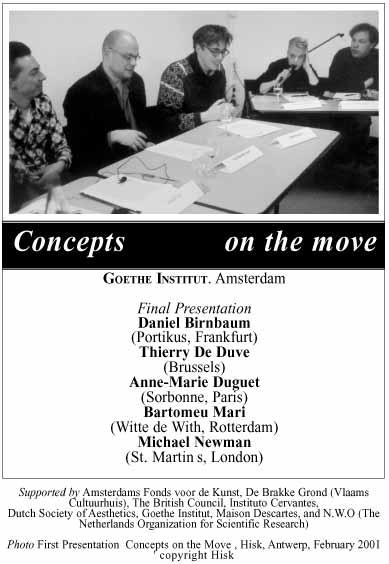
The concluding symposium in Amsterdam
evaluated the outcome of the ten
previous workshops. In stressing the
need to theoretically situate the
current generation of artists in a
topical discourse, the crucial role of
the concept of experience emerged.
How are the various perceptual and
conceptual constituents, or apparatus
if you will, of the artistic process
(of communication) modified and further
conceptualized by that concept of
experience? What is the current position
of forms of space and time? Could
these forms guarantee visual art's
universal i.e. intersubjective claim of
validity? How could a topical form
of aesthetic subjectivity be constituted?
Is that subjectivity entirely defined
by an awareness of temporality i.e.
delay, distance, deferred action and
trauma? Wouldn't the subject, then,
remain its own self-appropriation,
whereas a topical artistic subjectivity
seems to be characterized by a "being
with", a situational "interface", and
an urge for deictic exposure? At the
same time, a decisive claim for a novel
interpretation of the autonomous forces
occularcentrism, in the form of scopic
regimes, to lose its expressiveness.
PUBLICATION: Concepts on the Move
L&B (Lier en Boog), Series of Philosophy of Art and Art Theory,
Volume 17.
Info: www.rodopi.nl
Presentation Book: Panel discussion, Art Forum Berlin Talks, "Concept
meets Context",
in collaboration with Institut fuer Kunst im Kontext (Art University
Berlin), September 2002
---------------------------------------------------------------------
---------------------------------------------------------------------